Logo

Hiptech

Data Platform

From scattered data to clear decisions. Build data platforms you can trust.

Digital Transformation for SMEs

Practical, affordable technology that helps small businesses and startups work smarter.

Facebook LinkedIn
sales@hiptechvn.com(+84) 987 979 977
Contact Us • Contact Us • Contact Us •
© 2026 Hiptech Solution. All rights reserved.
Privacy PolicyTermsCookie Preferences
Hiptech LogoHiptech

Services

Products

  • Velasora
  • EV Charger
  • Magicblocks
  • AHA
  • Timesheet
  • Magicforms

Company

  • About us
  • Careers
  • News
  • Contact
Facebook↗LinkedIn↗
sales@hiptechvn.com(+84) 987 979 977
• CONTACT US • CONTACT US • CONTACT US
© 2026 Hiptech Solution. All rights reserved.
Privacy PolicyTermsCookie Preferences
EV Charging Station

Firmware engineered for reliable, connected EV charging

We develop embedded firmware for EV charging stations, connecting charging hardware, vehicle communication, device control, connectivity, and backend systems into reliable charging experiences.

Explore our workContact us
Overview

Connecting every layer of the

charging experience

An EV charging station brings together power electronics, embedded control, vehicle communication, connectivity, and backend services. Firmware coordinates these systems to keep every charging session safe, connected, and predictable.

HIPTECH develops embedded firmware for charging infrastructure with a focus on hardware control, communication, device management, diagnostics, and system integration.

0+MCU/SBC platforms
0+Communication protocols
0+Hardware interfaces integrated
0+Charging platforms developed
System expertise

Firmware across the

EV charging architecture

We develop firmware across the key components of connected charging stations, coordinating hardware control, communication, user interaction, and backend connectivity.
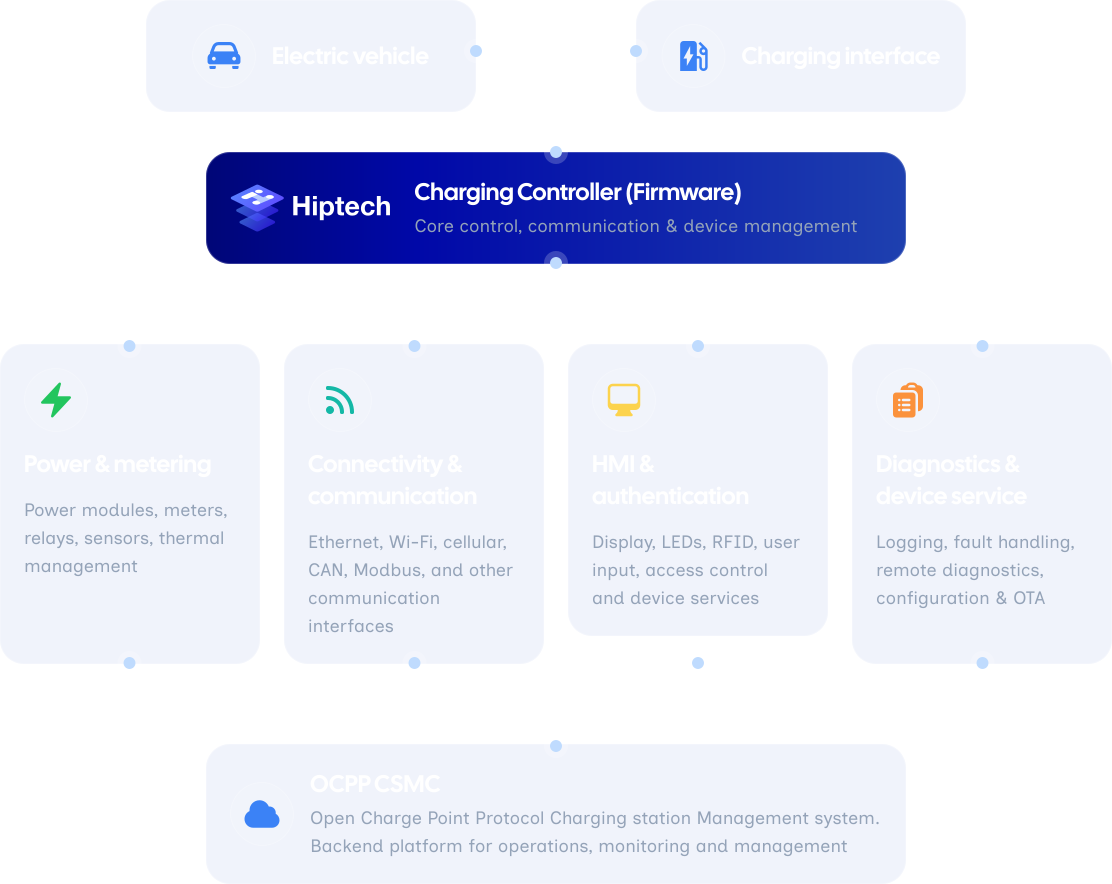
EV charging architecture
Firmware across the EV charging architecture
What we do

From embedded control to connected

charging infrastructure

We develop firmware across the core layers of EV charging systems, from low-level hardware control to communication, diagnostics, and backend integration.

MCU & embedded development

  • Firmware for ARM Cortex M and embedded MCUs.
  • Bare metal and RTOS development.
  • HAL and peripheral driver development.

Charging control & hardware Interface

  • Control of relays, sensors, meters, and power modules.
  • Real time voltage, current, and temperature monitoring.
  • Charging state and fault handling.

Communication & protocols

  • Integration of CAN, PLC, Modbus, UART, SPI, and I²C.
  • Developing ISO 15118-compliant digital communication between EVs and EVSEs to support Smart Charging and Vehicle-to-Grid (V2G) technology.
  • Charging and backend protocol integration (OCPP 2.0 and 1.6)

Connectivity & backend integration

  • Integration of Ethernet, WiFi, and cellular connectivity.
  • Exchange of status, commands, and transaction data.
  • Integration with charging management platforms.

Diagnostics & firmware management

  • Diagnostics, event logging, and fault reporting.
  • Bootloader, firmware update, and recovery.
  • Remote configuration and device monitoring.

Reliability & system integration

  • Integration across firmware, hardware, HMI, and backend systems.
  • Fault detection and recovery.
  • Stability testing and system debugging.
Development approach

From charging requirements to

field-ready firmware

01
System & requirement analysisUnderstand charging architecture, hardware components, communication requirements, operating scenarios, connectivity, safety constraints, and backend integration needs.
02
Firmware architecture & interface designDefine embedded modules, hardware interfaces, device states, communication layers, diagnostics, and firmware update mechanisms.
03
Development & system integrationImplement firmware functionality and integrate charging hardware, communication modules, connectivity, user interfaces, and backend systems.
04
Validation & deployment supportValidate charging workflows, communication, fault handling, firmware updates, interoperability, and long-running stability before field deployment.
Rocket icon

Let's build something great together.

Start a project